We use clean design, product thinking, and modern tools to help founders turn ideas into functional products, websites, and workflows - without the usual complexity.
CASE STUDY
Doctle Bio
The Gap in the Digital Identity Layer
Introduction
Doctors accumulate years of effort, training, and credibility. Yet their professional presence online looks nothing like the journey they’ve lived. Most rely on outdated hospital pages, low-effort bios, or scattered PDFs. When we heard a senior doctor say, “I have no single link that tells my story properly,” the idea for Doctle Bio became clear.
Doctle wasn’t born from the idea of making a profile tool.
It was born from the belief that medical professionals deserve a digital identity that reflects the seriousness of their work.
Designed Around the Modern Practitioner
Persona
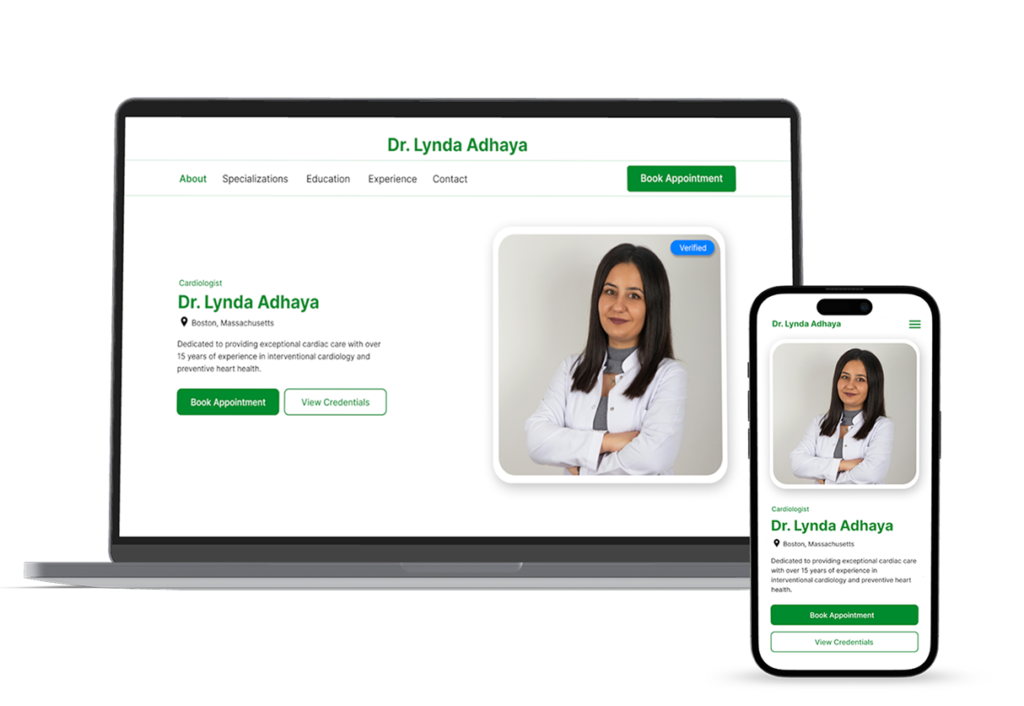
We built our earliest persona around a cardiologist in his early 30s. He had strong academic credentials, multi-hospital experience, and a growing practice. What he wanted wasn’t a full website — it was something simpler, structured, and professional.
He didn’t want to “look like an influencer.”
He wanted to look like a doctor.
This persona anchored every decision we made.
The Insight That Shaped Our
Product Direction
Doctors do not think in “marketing sections.”
They think in:
their education lineage,
the places they’ve practiced,
the specialisation they built,
the credibility they’ve earned through awards and publications.
Identity-first, not feature-first.
That insight became the product’s backbone.
How We Approached
Building Doctle
We treated Doctle like a SaaS identity system — not a content tool. The goal of the MVP wasn’t to solve every workflow doctors have. It was to solve one problem exceptionally well:
give them a clean, professional digital identity they can share everywhere.
So we built:
a structured identity builder,
a modern, medical-first template,
flexible sections based on professional logic,
a frictionless publishing experience.
Everything else — appointments, review systems, reminders — intentionally stayed out of the MVP so we didn’t dilute clarity.
Designing With Trust as the
Primary UX Metric
If the interface didn’t feel trustworthy at first glance, doctors wouldn’t use it.
So we leaned into “clinical minimalism” — calm colors, predictable sections, clean typography, and simple scanning patterns.
One early user said:
“This feels like a space made for doctors, not content creators.”
That sentiment validated the design approach more than any metric.
Design Tools: The entire identity layer was prototyped in Figma, using atomic UI components to ensure consistency across web and mobile layouts.
Building the MVP Like a Scalable SaaS
The MVP
The architecture supports modular growth. Every profile section is independent, allowing us to add functionality without breaking the simplicity of the experience.
We kept the onboarding incredibly short.
Doctors should be able to publish their profile faster than making a cup of tea.
This constraint helped us maintain focus, avoid bloat, and ship fast.
Tech Stack: The MVP was built using a modular architecture on React (Next.js) paired with a structured backend using Supabase/Firebase, allowing fast iteration and flexible profile modules.
Early Success Signals
The Metrics That Matter
Even without marketing pushes, we observed healthy, promising behaviour:
Profile Completion Momentum
Doctors who began the onboarding process finished most of their profile in one sitting — a sign that the product is intuitive and valuable.
Adoption Points
Users began placing their Doctle link on WhatsApp, Google Business, clinic boards, and conference bios. This shows the profile is fitting organically into their workflows.
Return Edits
Doctors returned to update experience, timings, and credentials — the kind of behaviour that gives identity-based SaaS products stickiness.
These are the metrics we track to evaluate product-market alignment — not vanity numbers.
Analytics Layer: Basic analytics were implemented using Plausible Analytics, giving us privacy-focused insight into profile visits, section engagement, and return behaviour.
About Digital Identity for Doctors
What We Learned
Doctors don’t want heavy systems.
They don’t want dashboards filled with features.
They want clarity.
Doctle delivered that clarity, and that clarity delivered trust.
Our biggest insight:
when identity becomes simple, doctors use it everywhere.
That’s when a tool becomes a habit.
Building Beyond the Identity Layer
Roadmap
Doctle's growth follows a simple arc:
Identity → Interaction → Workflow.
What’s coming:
appointment flows woven into profile pages,
token systems for clinics,
WhatsApp follow-up automations,
verified identity badges,
discovery features that prioritize trust over ranking.
Each new feature extends the profile’s value without complicating its essence.
Future Stack Additions: To support verified credentials and secure identity checks, the next phase of Doctle integrates serverless functions, encrypted document storage, and optional third-party verification APIs.
UI Designed
Visual Recommendations
Conclusion
The Identity Layer Doctors Always Needed
Doctle is still evolving, but its core purpose is already clear. Doctors finally have a digital identity platform that respects their profession, organises their journey, and presents them with quiet confidence. It’s simple enough to use instantly and structured enough to grow with their career.
In many ways, Doctle isn’t just a product.
It’s a long-overdue foundation — the digital starting point every doctor should have from their very first day in practice.
In many ways, Doctle isn’t just a product.
It’s a long-overdue foundation — the digital starting point every doctor should have from their very first day in practice.
WE BELIEVE
Best Stack for Our Clients
TESTIMONIALS
Our Client Says
“Our philosophy is built on people who are addicted on creating, learning, and growing together, which allows us to discover better others miss.”
View
Next Project
End to End School Operations Management System for New Age Schools
Learn More